Billing setup
Configure how charges are priced and applied, layer by layer: organization defaults, service-level overrides, per-patient exceptions, and the simulator that previews the result.
Billing setup
Configure how charges are priced and applied, layer by layer: organization defaults, service-level overrides, per-patient exceptions, and the simulator that previews the result.
Find billing configuration and learn the three layers
All billing configuration lives in the Billing Command Center (Admin > Billing). The left sidebar groups screens into Operations (day-to-day work), Programs, and Configuration (setup). Everything in this part lives under Configuration, and almost every rule resolves through the same three-layer hierarchy.
- Open
Admin > Billing. The Command Center opens on the Dashboard. Confirm the practice name and payment model in the header (for example, Dr. Romero's Practice · Insurance) — the payment model decides which configuration tabs appear. - Find the Configuration group in the sidebar. It holds
Payment Model,Collections & Fees,Service Menu,Subscriptions,Charge Fees,Negotiated Rates,Claim Submission,Billing Identity,Auto Modifiers, andSimulator. - Learn the three layers. Collections & Fees sets the organization default; the Service Menu adds per-service overrides; the patient chart's Billing tab adds per-patient exceptions. Each layer only changes what it explicitly sets — anything left on Use organization default inherits from the layer above.
The Configuration tabs
- Payment Model — insurance, cash-pay, subscription, or hybrid; sets which tabs apply.
- Collections & Fees — organization-wide collection, fee, and guard defaults.
- Service Menu — per-service pricing and collection overrides.
- Subscriptions / Charge Fees — recurring memberships and one-time fees.
- Negotiated Rates — the contracted amounts you've agreed with each payer, used to price patient responsibility.
- Billing Identity / Auto Modifiers — the billing entity that appears on claims, and rules that add CPT modifiers automatically.
- Claim Submission / Simulator — clearinghouse setup, and a full-lifecycle dry run of a visit from booking through payer response.
The three layers
- Organization default — Collections & Fees. The baseline for every visit and patient.
- Service override — Service Menu. Per provider + visit type.
- Patient exception — chart Billing tab. Per individual patient.
- Most specific wins — a patient rate beats a service price, which beats the org default.
Set organization billing defaults in Collections & Fees
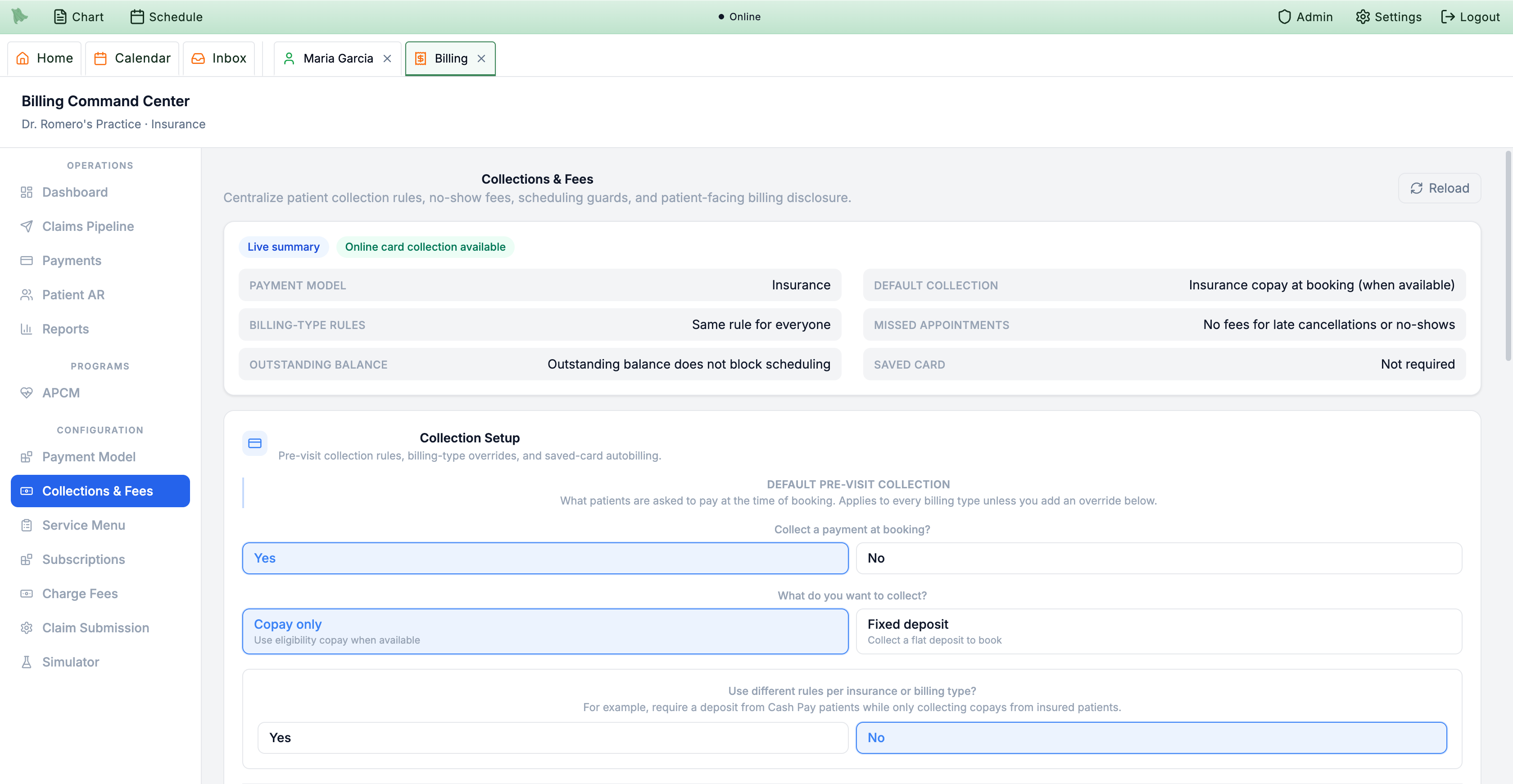
Collections & Fees is the organization-wide baseline — the rules applied to every visit and every patient unless a service or patient overrides them. A Live summary across the top recaps the current posture (payment model, default collection, billing-type rules, missed-appointment fees, outstanding-balance guard, saved card) so you can see the effect of your changes at a glance.
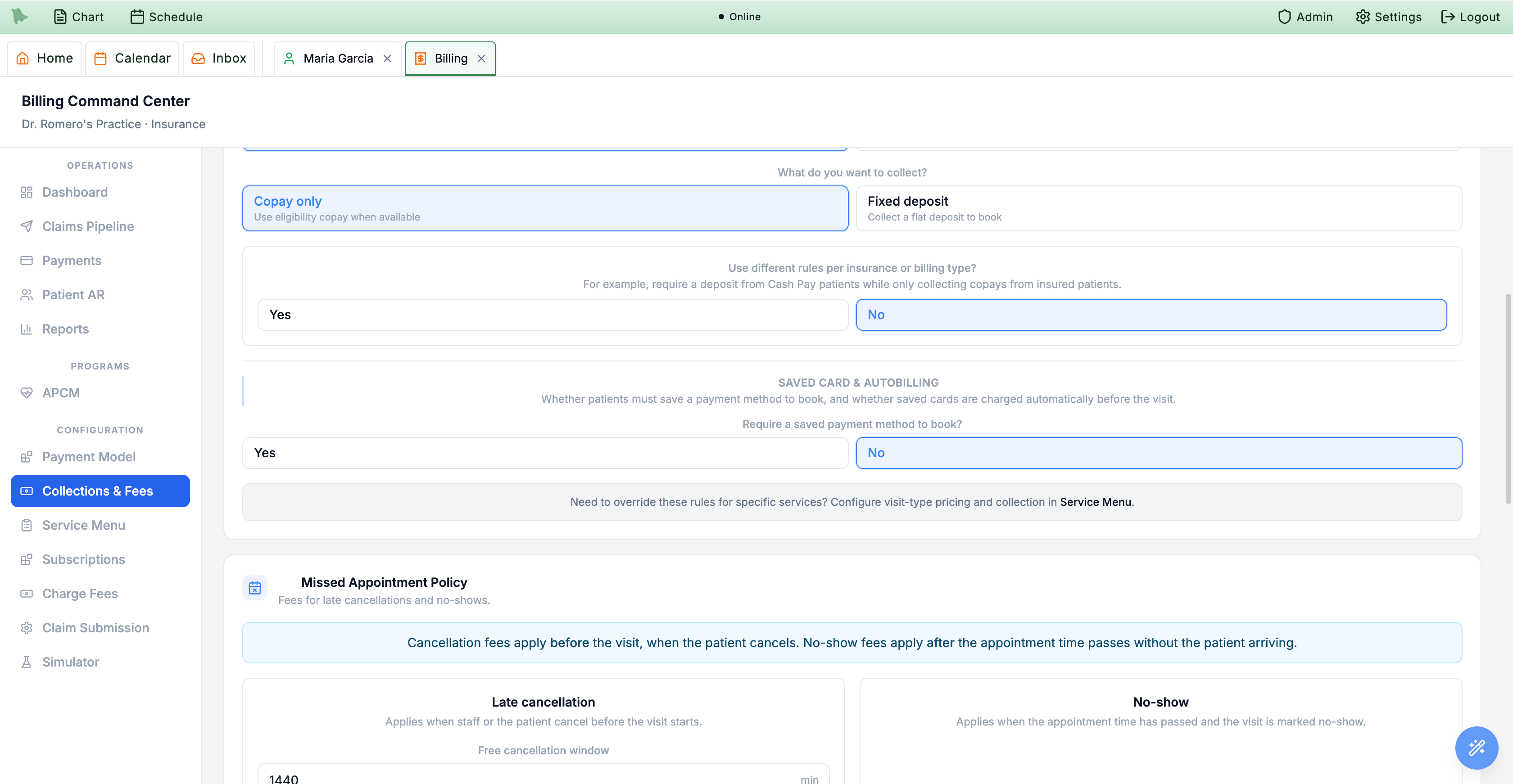
- Default pre-visit collection. Collect a payment at booking? (Yes / No), and if yes, What do you want to collect? — Copay only (use the eligibility copay when available) or a Fixed deposit. Turn on Use different rules per insurance or billing type? to vary by payer — for example, require a deposit from Cash Pay patients while collecting only copays from insured ones, with cash-pay upfront options of No upfront, Full cash price, Fixed deposit, Percent of price, or Office review. Turning that on also reveals a No-gate / no-charge insurance types checkbox grid — ticked billing types bypass organization-level visit collection, saved-card gating, and visit collection charges entirely (Service Menu overrides still apply).
- Saved card & autobilling. Require a saved payment method to book? (Yes / No), and whether saved cards are charged automatically before the visit — Off, Simulate, or Live — with a lead time (hours), retry count and backoff, and a failure action (Staff review or Mark unpaid).
- Patient responsibility billing. Auto-bill patient responsibility from eligibility? turns on automatic collection of an insured patient's deductible, coinsurance, and copay from their eligibility (271) data. Turning it on opens an Enable patient-responsibility billing? confirmation that counts how many of your active insurers have a negotiated contract and names the ones that don't. Then choose When to collect — After adjudication (card on file, charge the real cost once the payer responds; recommended) or Estimate up front, which adds How much to pre-charge (Copay only or Full estimate) and an over-collection choice (Credit + manual; Auto-refund is shown but not yet available) — plus an Eligibility freshness window in days.
- Missed appointment policy. Late cancellation: a free-cancellation window (minutes) and a fee of No fee, Fixed $, or Forfeit deposit. No-show: a fee of No fee or Fixed $. Cancellation fees apply before the visit; no-show fees apply after the appointment time passes. The same card holds No-show handling — Manual (staff mark missed visits no-show) or Automatic, with a Timing preset, a Minutes after grace value, and a toggle for whether telehealth visits are included. The Live summary reflects the choice as Auto… or Manual no-showing.
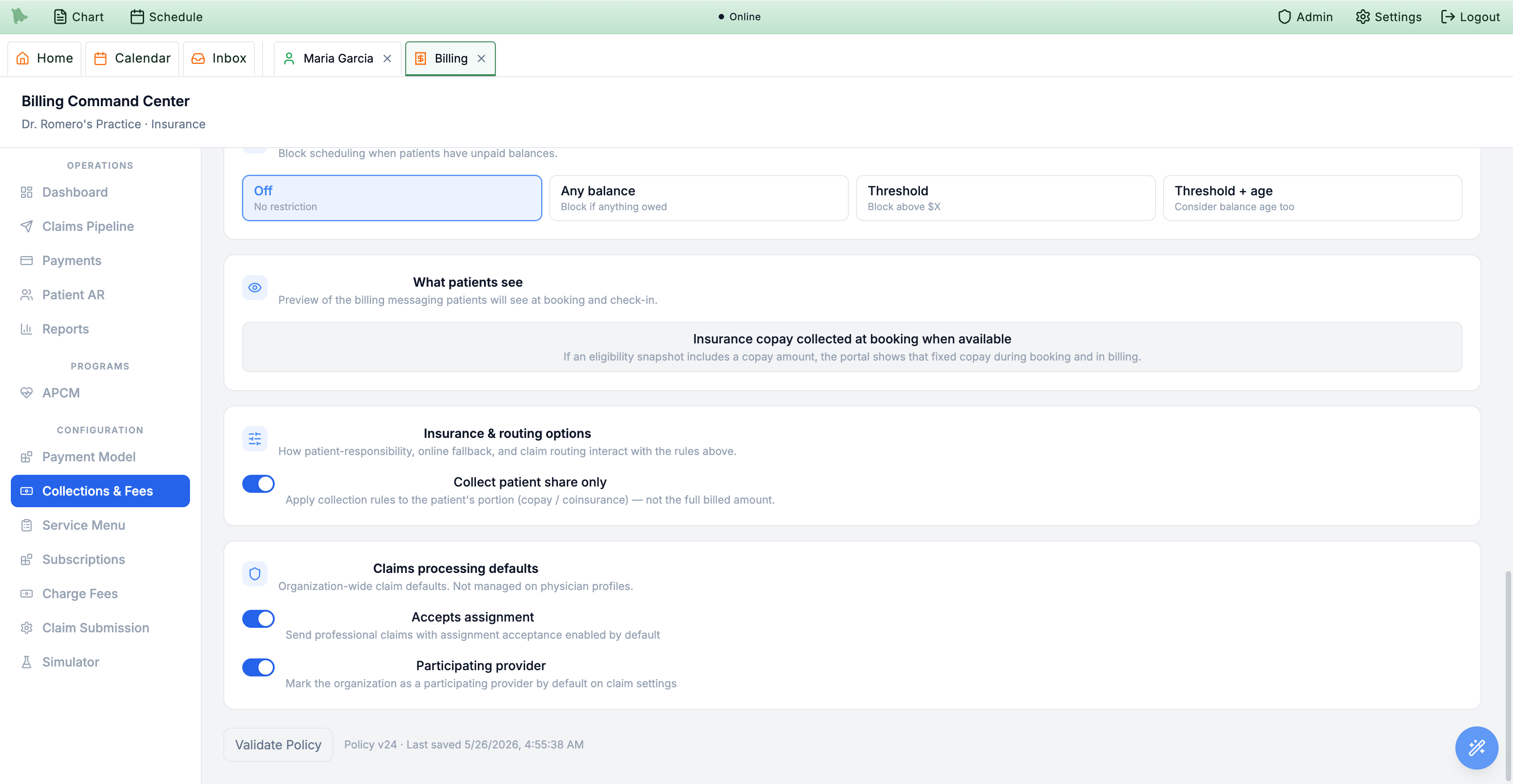
- Outstanding balance & scheduling. Decide whether an unpaid balance blocks new appointments: Off, Any balance, Threshold (block above $X), or Threshold + age (also weigh how old the balance is). An optional payment-plan exception lets enrolled patients keep scheduling.
- What patients see. A live preview of the exact booking and check-in messaging your settings produce — useful for confirming the patient-facing wording before you save.
- Insurance & routing options. Collect patient share only applies the collection rules to the patient's portion (copay / coinsurance) rather than the full billed amount; an online-fallback option lets cash-only offices still take portal payments.
- Claims processing defaults. (Insurance-style payment models.) Organization-wide claim defaults — Accepts assignment and Participating provider — applied to professional claims; set here, not on physician profiles.
- Validate and save. The controls change with your edits. While you have unsaved changes, an amber Unsaved changes banner sits at the top of the tab with
Validate,Save changes, andDiscard. Once everything is saved the banner disappears and the footer at the bottom shows aValidate Policybutton beside the policy version and last-saved time. Either way, validating checks the combination for conflicts before you commit.
Override pricing and rules per service in the Service Menu
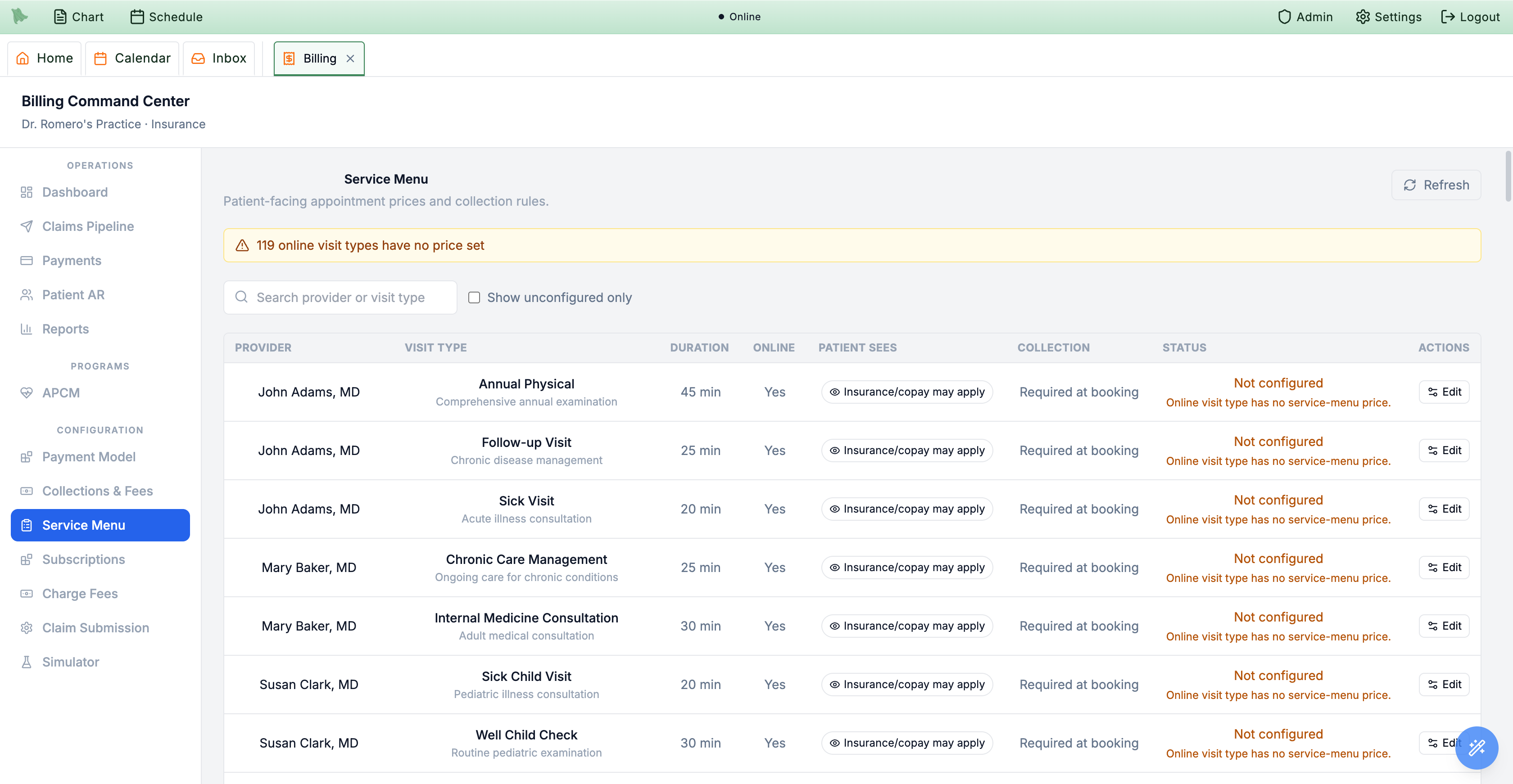
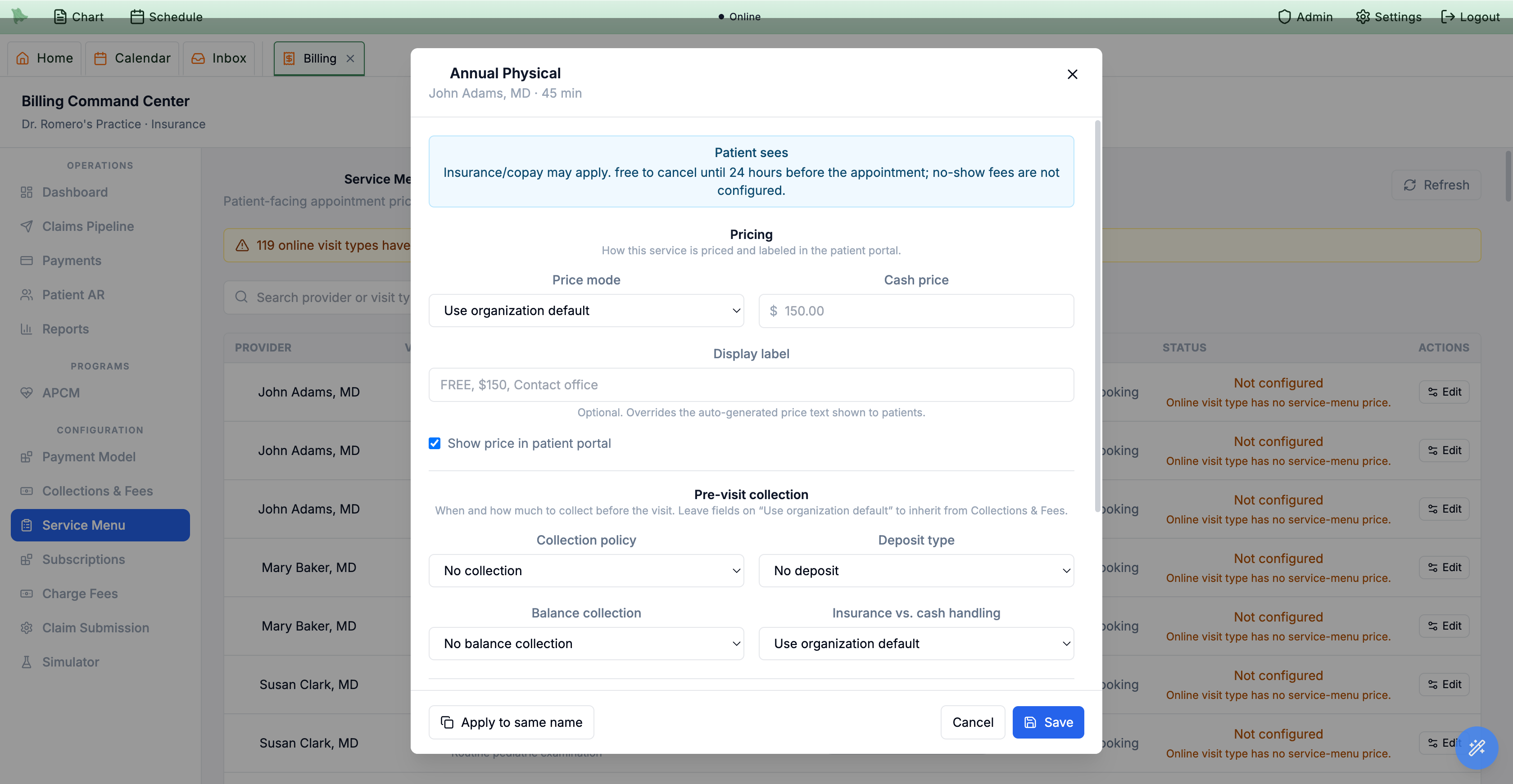
The Service Menu lists every service — a provider paired with a visit type — alongside the patient-facing price and collection rule. Any service can override the organization defaults from Collections & Fees; leave a field on Use organization default to inherit it. This is how a free telehealth check-in and a $250 cash physical can live in the same practice.
- Open the
Service Menutab. The table lists each service with Provider, Visit Type, Duration, Booking, Patient Sees, Collection, Status, and Actions. Booking reads Public (bookable from your public site), Portal (patients can self-schedule it from the portal), Public + Portal, or Staff only. A banner counts online visit types that still have no price set, and the Status column marks rows that carry service-level overrides. - Edit a service's pricing. Click
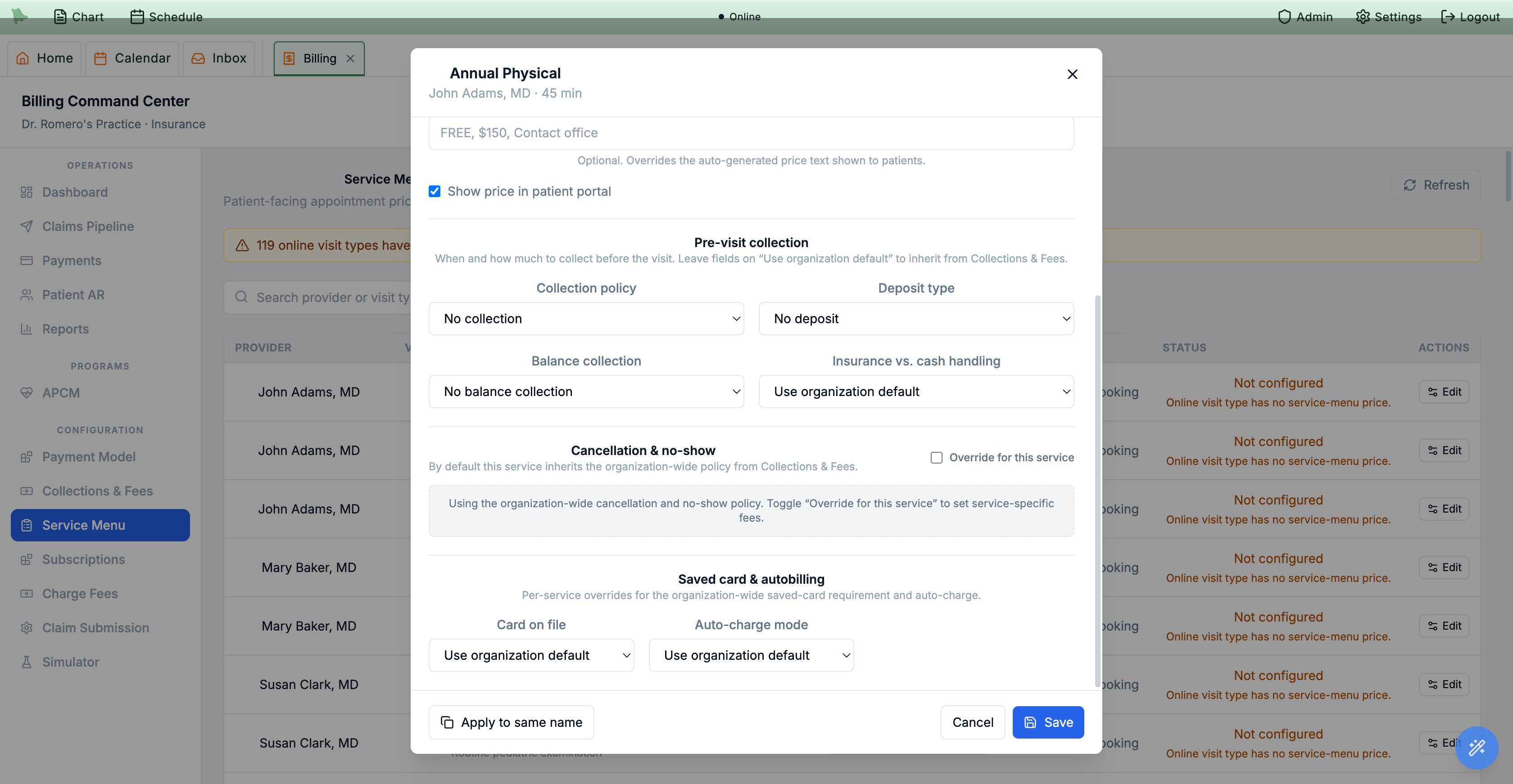
Edit. Price mode offers Use organization default, Free, Fixed cash price, or Office review; set the Cash price, an optional Display label (for example FREE, $150, or Contact office) that overrides the auto-generated price text, and Show price in patient portal. - Set pre-visit collection for the service. Collection policy ranges across No collection, Card on file, Required at booking, Suggested before visit, Required before visit, Collect at check-in, and Invoice after visit, with deposit type/amount/percent, balance collection, an hours-before-visit window, and an Insurance vs. cash handling choice (Use organization default, Insurance when available, Cash only, or Office review).
- Override cancellation & no-show (optional). By default the service inherits the organization policy. Tick Override for this service to set a service-specific cancellation window and fee and a no-show fee; leave it unchecked to keep using Collections & Fees.
- Override saved card & autobilling (optional). Card on file and Auto-charge mode each default to Use organization default; switch either to require/skip a card, or to Off or Simulate auto-charge, for this service only. Live is not yet usable at the service layer — picking it shows “Live pre-visit auto-charge is unavailable until the auto-charge worker is deployed” and greys out both
SaveandApply to same nameuntil you choose something else. - Save. Use Apply to same name to push the same settings to identically named services across other providers in one step.
Override billing for one patient from Patient Information
The narrowest layer applies to a single patient and beats both the service and organization rules. It lives on the patient’s chart, not in the Billing Command Center: open the patient’s Patient Information screen from the header strip, then the Custom Billing Rules tab under Financial.
- Open the patient and the
Custom Billing Rulestab. In a patient chart, click the patient’s name in the header strip. Physicians and admins land on the Patient Information page in its ownInfo: {patient}workspace tab; staff without chart permissions get the same screen as a dialog. In the sidebar, the Financial group holdsCustom Billing Rules,Insurance, andInvoices & Charges— the two billing tabs appear only for admins and for staff whose permissions allow them. The full screen is documented in §7.8. - Set exceptions. Bypass card on file means card requirements won’t block this patient from booking; Bypass booking collection moves any booking-required collection to check-in for this patient.
- Set per-patient cash rates. Expand the
Cash charge ratesaccordion (it starts collapsed and loads its table the first time you open it). It lists every visit type and provider with the read-only Service rate (the inherited service-level default) beside an editable Patient cash rate. Leave it on Default to inherit, or type an amount and Save to override; the reset button clears an override and returns the patient to the service rate. - Reclassify on the
Insurancetab (related). The neighboringInsurancetab carries Bypass insurance (treat as cash pay) and a manual Billing type — use these to move a patient to self-pay or set their billing classification. See §7.10. - See what this patient actually owes (related). The
Invoices & Chargestab is the money view for one patient: available credit and open-charge counts, every invoice (each insurance invoice expanding into its read-only claim panel), and an Issue a charge or credit form with a required reason, above a log of issued charges and credits. It shows the same invoice records as the Billing Command Center’s Invoices view — see §5.11 and §7.16.
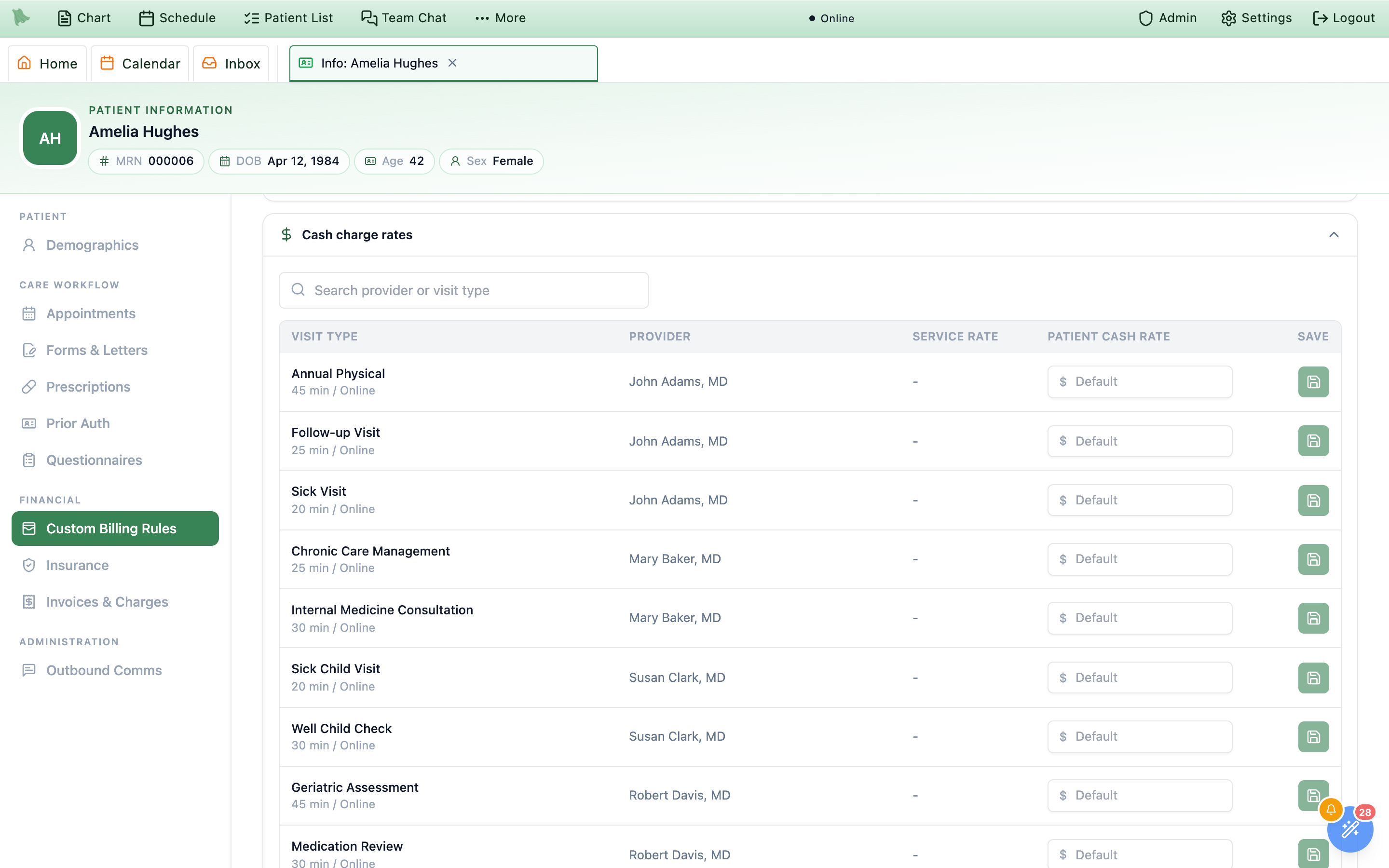
Custom Billing Rules tab with Cash charge rates expanded. Each row’s effective price is the patient cash rate when set, otherwise the service rate, otherwise the organization default.Preview the result with the Simulator
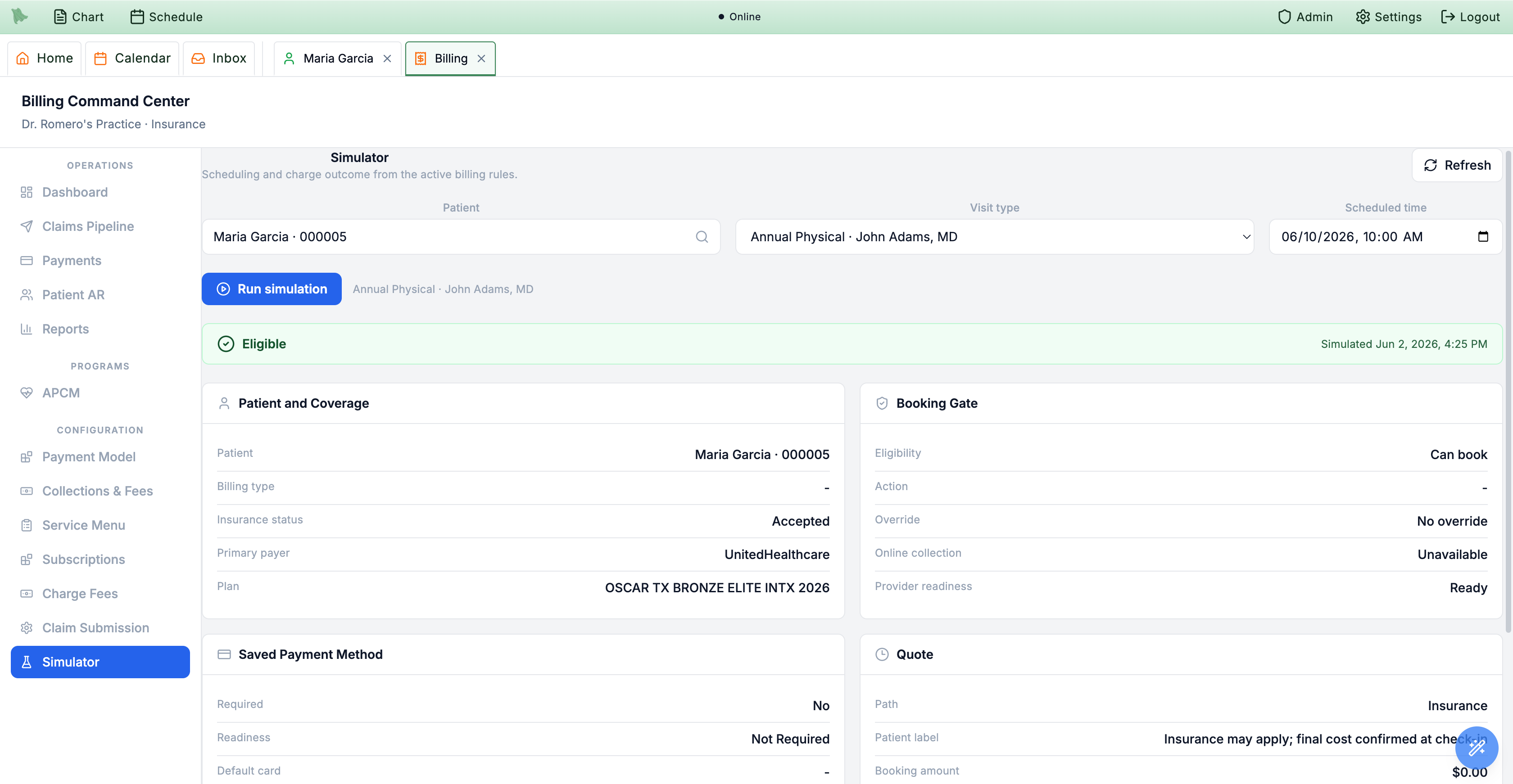
The Simulator answers “what will actually happen if I book this?” without touching a real appointment. It runs a real or made-up patient through the entire billing pipeline — booking gate, pre-visit collection, charges, claim, 837P, payer response, and the balance that lands on the patient — against your live rules. Nothing is saved: every write is rolled back, and the result is stamped “SIMULATION — nothing was saved; all writes were rolled back.”
- Choose the patient. A Fictitious patient / Real patient toggle sits at the top; Fictitious patient is the default so you can test a scenario you don't have a chart for. A fictitious patient takes a Name, Billing type (Default (insurance) or Cash pay), Coverage (Insured (active), Insured (coverage lapsed), or Uninsured), Plan type, Payer name (try Medicare Part B or Medicaid KY to exercise government-payer rules), and a QMB (balance-billing protected) checkbox. Switch to Real patient and Select patient to run someone from your chart instead.
- Describe the visit. Set the Visit type (any provider + visit type), the Scheduled time, the Service codes (for example 99214, 90833x1, J2426), the Diagnoses (ICD-10), and the Telehealth patient location — Not documented (POS 02), Home (POS 10 — non-facility rate), or Other location (POS 02).
- Pick a payer response. The Payer response scenario block decides how the imaginary payer answers: Paid in full, Patient responsibility split, Underpaid, Overpaid, Denied, Duplicate (OA-18), or Reversal (CLP-22). Set an Allowed amount (blank means the billed amount), and the scenario adds its own fields — copay, deductible and coinsurance for a responsibility split; a Group code and CARC for a denial; an Overpaid by or Underpaid by amount for the others.
- Click
Run full lifecycle. The results come back as a stack of expandable stage cards, each colored by outcome and carrying any warnings: Patient & coverage, Booking gate, Pre-visit collection, Visit & signing charges, Claim generation, Readiness, routing & 837P, Payer adjudication, and Balance & aftermath. - Expand a stage to see why. Every card opens onto a Rules in effect table — the rule that fired, the value it resolved to, and where to go and change it — plus that stage's figures. The submission stage shows an 837P preview and the adjudication stage a Synthetic 835, so you can read the actual EDI the claim would have produced.
- Check what was suppressed. Below the stages, Side effects that WOULD have fired (suppressed by the simulator) lists the background jobs a real run would have queued — your confirmation that the dry run stayed a dry run.
How a charge is decided, and common gotchas
When Hero quotes a patient at booking or check-in, it resolves the three layers from most specific to least: the patient's exception or cash rate first, then the service-menu override, then the organization default. Use the Simulator (§5.5) to preview the resolved outcome for any patient and service.
Resolution order
- 1 · Patient — a cash-rate override or exception on the chart Billing tab.
- 2 · Service — the Service Menu price mode and collection policy.
- 3 · Organization — the Collections & Fees default.
- The first layer that sets a value wins; lower layers fill in the rest.
“No service-menu price”
- Online visit types must have a price before the portal can show one.
- Set Price mode on the service, or rely on the org copay default for insured patients.
- The Service Menu banner counts how many online visit types are still unpriced.
Patient charged the wrong amount
- Check the patient's Cash charge rate and Exceptions first.
- Then the service's Price mode and Collection policy.
- Then Collections & Fees — the
Simulatorhelps confirm the result.
Cash patient still asked for copay
- Set Bypass insurance (treat as cash pay) on the patient's Insurance tab.
- Or set the service's Insurance vs. cash handling to Cash only.
Patient blocked from scheduling
- The org Outstanding balance & scheduling guard is on.
- Collect the balance, enroll a payment plan (if the exception is allowed), or relax the guard.
- This guard also interacts with follow-up outreach in Scheduling > Patient Notifications.
Card-on-file requirement blocks booking
- Confirm the requirement is intended at the org or service layer.
- For an exception, tick Bypass card on file on the patient's Billing tab.
Need help? Email support@heroemr.com.